
How to Search Criminal Dockets
Begin with the court, not a broad name search. Felony cases belong to Lanier County Superior Court and use PeachCourt. County traffic matters go through Probate Court and Georgia Probate Records. Magistrate calendar and ordinance information uses Georgia Magistrate Records. Lakeland and Ray City citations remain with their municipal clerks. This split matters because one portal will not return every Lanier County criminal docket.
Have the case or citation number if possible. A full name and a useful date range can narrow a lower-court search. The published research found no official Lanier Superior case-number pattern, so do not add a guessed year prefix or criminal code. When an online record is incomplete, call the Superior Clerk at 229-482-3594, Probate Court at 229-482-3668, or Magistrate Court at 229-482-2207.
- Identify the court from the notice, citation, or offense level.
- Open that court's official provider and use the exact known number or name.
- Match the court, filing date, and charge before opening a result.
- Read entries in order, separating settings from completed events.
- Ask the responsible clerk for a public or certified copy when needed.
Lanier Felonies Use PeachCourt
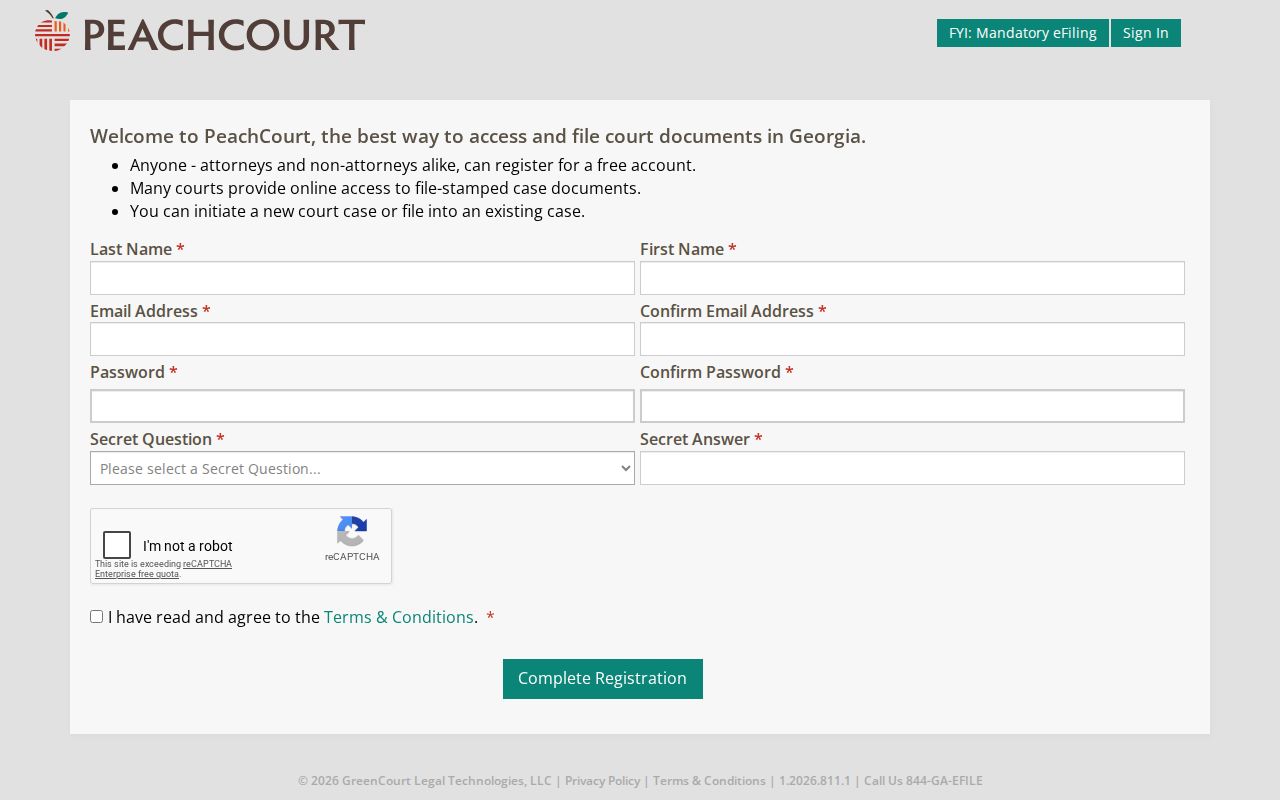
Georgia's official E-Access directory routes Lanier County Superior Court users to PeachCourt. The service requires an account. Its public login screen shows email and password fields, while the registration screen asks for a name, email, password, secret question and answer, agreement, and verification. Registration is not itself a Lanier County criminal docket search.
The captured PeachCourt login page shows that account gate before Superior records can be reached.

That gate also explains why the exact post-login filters should not be guessed. The separate PeachCourt registration page documents the fields needed to create a free account.
Provider help says docket data commonly reaches back to 2005, but individual coverage can vary. Older material and certified records still route to the clerk.
What a Criminal Docket Shows
A Lanier County criminal docket is a chronological case index, not a verdict summary. Read the charge as an allegation unless a later disposition resolves it. A scheduled hearing is not proof that the hearing occurred. Likewise, a bond entry is not a fine. The public AJC calendar provides labels and times, but not a full case-level record.
| Case Number | The court's identifier. No official Lanier format is published, so copy it exactly. |
|---|---|
| Charge | The alleged offense, statute, and classification when the public view supplies them. |
| Settings | Arraignment, motions, calendar call, plea, bench trial, or jury trial dates. |
| Orders and Plea | Filed rulings and any plea entered in the case record. |
| Disposition | The recorded resolution, sentence, costs, or appeal indicator. |
Document images are separate from docket lines. PeachCourt may charge for images and excludes sealed, adoption-related, and proposed unsigned documents. Obtain an authenticated record from Clerk Patricia L. Bass when legal proof is required.
Lanier Criminal Calendar Codes
The Alapaha Judicial Circuit calendar uses short labels that describe blocks of court work. They do not identify every case. Match the calendar to the individual Lanier County criminal docket before relying on a date.
- Felony CC/Pleas
- A felony calendar-call and plea block.
- Misd CC/Pleas
- A misdemeanor calendar-call and plea block.
- Crim Motions/Pleas
- A block for criminal motions and pleas.
- Arraign.
- An arraignment block, not proof that a plea was entered.
Lanier County has no published local glossary for disposition codes such as dismissal or nolle prosequi. Use the full entry or order, not an assumed abbreviation.
Stages on a Criminal Docket
A Lanier County criminal docket may start with a complaint, accusation, or indictment. Bond or first-appearance material may follow. Arraignment records the formal plea stage, while later entries can set motion hearings, calendar calls, pleas, or trials. The register should then show the disposition and sentence when the case is resolved. If review is sought, the appeal creates a distinct record in the Georgia Court of Appeals or Supreme Court of Georgia.
Docket flow: Filing › Arraignment › Pretrial › Plea or Trial › Disposition › Sentencing
Not every case uses every step. Compare dates and filed orders. A reset changes the setting, while a dismissal resolves a case. Those two entries should never be treated as the same event.
When PeachCourt Has No Document
A blank image link can have several causes. The document may predate the provider's coverage, remain available only at the clerk's counter, carry a fee, or fall within an exclusion. Sealed records and proposed unsigned orders are not made public through PeachCourt. A missing file is therefore not proof of dismissal or proof that the Lanier County criminal docket does not exist.
Best next step: Note the case number and docket-entry date, then ask the Superior Clerk whether a public copy may be inspected or ordered.
The Superior Clerk's counter is at 56 W. Main Street, Suite 5, Lakeland, Georgia. It is open Monday through Friday from 8 a.m. to noon and 1 to 5 p.m. Call before travel to confirm the copy method and current fee.
Which Court Holds Criminal Dockets
Lanier County Superior Court hears felonies. Magistrate Court handles warrant applications, preliminary criminal proceedings, county ordinance matters, and its published criminal-offense and deposit-account-fraud schedule. Probate Court administers the county traffic docket. Municipal courts retain Lakeland and Ray City traffic and ordinance cases.
| Matter | Custodian | First channel |
|---|---|---|
| Felony | Superior Clerk | PeachCourt |
| Preliminary or ordinance | Magistrate Court | Magistrate calendar or office |
| County traffic | Probate Court | Georgia Probate Records |
| City citation | Municipal clerk | City channel |
The Alapaha Judicial Circuit serves Lanier with Atkinson, Berrien, Clinch, and Cook counties. A 2026 law created a third Superior judgeship, but the circuit remains one regional court system. Its roster and contacts appear in the official directory.
The circuit page helps identify the Superior layer, while each docket must still be confirmed through the clerk or proper provider.
Lanier Circuit Court Contacts
Calendar questions can require a court contact rather than a record search. The Alapaha directory lists a Lanier judicial-assistant office at 56 W. Main Street, Suite 9, with phone 229-363-2944. Court Administrator Bridgette Cersey is listed at 229-686-6177. These offices can help confirm circuit scheduling, but the Superior Clerk remains the custodian for a criminal docket or certified filing.
The source for those assignments is the Alapaha court directory.
Use the case number when calling. Asking whether a named setting remains active is more precise than asking for every criminal matter on a given day.
Lanier Juvenile Dockets Stay Restricted
The circuit calendar can publish DJJ or DFCS as a session label without opening the cases placed in that block. Lanier's Superior Clerk manages Superior and Juvenile records, yet Georgia's Juvenile Data Exchange is reserved for authorized attorneys and carries a confidentiality notice. A public calendar label must not be used to infer a child's identity, charge, or outcome.
If a person has a lawful need for a juvenile record, the correct route is the clerk or Juvenile Court. A missing PeachCourt result does not mean the matter never existed. It can reflect statutory limits, a sealed portion, or the fact that the public provider does not carry that record class.
Note: Calendar visibility and case-file access are separate questions under Georgia law.
Public Access and Sealed Criminal Dockets
Georgia favors public access, yet criminal records can contain protected parts. Juvenile files, sealed material, adoption-related documents, unsigned proposed orders, personal identifiers, and information protected through judicial-security rules may not appear. The Superior Clerk manages Superior and Juvenile records, but JDEX is an authorized-attorney exchange, not a public juvenile search.
Uniform Superior Court Rule 21 states that court records are public unless access is limited by law or procedure. A restriction should identify its scope, nature, duration, and reason. Ask the clerk for the legal basis when access is denied, and request any public redacted portion. Do not try another portal to evade a restriction.
Key rules: Uniform Superior Court Rule 21 governs public access and limitation orders. The Georgia Attorney General's records guidance explains timing, cost, and redaction principles for public records.
For an open record that is not online, request it from the office that keeps it. Phone first, visit the proper counter, or use the Probate/Magistrate records form for those courts. Superior mail and email procedures were not published. The Lanier County case search provides more detail on choosing among the portals.