
How to Search the Lanier County Court Docket
Start with the court, not just a name. That is the first rule of any Lanier County docket search. Felonies, divorces, and major civil matters land in Superior Court. Small civil claims, dispossessories, garnishments, and county ordinance issues usually go to Magistrate Court. Probate files and county traffic cases move through Probate Court. A ticket written by Lakeland or Ray City stays with that city's municipal court. It only becomes a county record if later filings create one.
Collect the party name. Gather the case or citation number, an approximate filing date, and the case type. Then pick the channel that fits the court. A blank result can mean a wrong portal, a spelling slip, or an older file. It can also mean an entry too new to show, or a restricted record. It does not prove the Lanier County court docket is missing.
- Identify whether the matter is Superior, Probate, Magistrate, Juvenile, or municipal.
- Open the official provider for that court and select Lanier County when requested.
- Search by case number when known, or use a party name and narrow date range.
- Read the result for filing events, status, disposition, and the next court setting.
- Contact the responsible clerk for a missing image, older file, or certified copy.
Georgia Courts keeps an official E-Access provider directory. It points Lanier Superior Court users toward PeachCourt rather than serving as one statewide results database.
Four Lanier County Docket Paths
Lanier County records live in several systems. PeachCourt is the account-based route for Superior Court. Georgia Magistrate Records handles participating Magistrate civil, ordinance, and calendar categories, while Georgia Probate Records covers probate and traffic. Municipal citations stay with city channels.
| Search goal | Official route | Main limit |
|---|---|---|
| Superior felony or major civil | PeachCourt | Account required; images may carry fees |
| Magistrate civil or ordinance | Georgia Magistrate Records | Only participating categories appear |
| Probate or county traffic | Georgia Probate Records | A listing may not include a document PDF |
| City citation | Lakeland or Ray City channel | County portals do not replace the city |
Failed searches usually trace back to this split. Pick the right office before concluding a Lanier County case does not exist.
What a Lanier County Court Docket Shows
A docket is an event index, not the whole file. It can show that a complaint, motion, order, or disposition was entered. But it does not show the filing itself. PeachCourt separates docket information from document images, and some images cost extra. The public Alapaha calendar is even thinner. It gives a county, a time, and a setting type, often with no case name at all.
| Case Number | The court's identifier. No single countywide format applies to every court. |
|---|---|
| Parties | Names tied to a public case, subject to sealing and redaction rules. |
| Docket Entries | Dated filings, notices, orders, and other recorded events. |
| Hearing Settings | The scheduled date and type when the public system supplies them. |
| Court and Judge | The court assignment or judicial officer when included. |
| Disposition | The recorded outcome or status, checked against the latest entry. |
Silence in an entry proves nothing about outcome. When the event list lacks the paper that explains a line, ask the clerk for the public case file.
Lanier Dockets and Filed Documents
Three items, three purposes. The docket sheet tells you what happened in order. A filed document holds the actual pleading, order, or notice. A certified copy is a clerk-authenticated reproduction of either. One portal result rarely delivers all three.
- Docket entry
- A dated line recording a filing, setting, order, or event.
- Setting
- A scheduled event, such as an arraignment, motion hearing, calendar call, or trial.
- Continuance
- A court-approved move of a setting to a later date.
- Disposition
- The result recorded for a case or charge.
- Certified copy
- A copy authenticated by the office that keeps the original record.
The difference matters when you need the words of an order, not just proof that one was entered. That is when the document itself, certified if necessary, becomes essential.
Which Lanier County Courts Keep Dockets
Georgia sorts court work by subject and case level. Lanier County sits in the five-county Alapaha Judicial Circuit. The Superior Clerk manages Superior and Juvenile records, while Probate and Magistrate staff keep their own lower-court material. City clerks hold municipal cases.
| Court | Docket covers | Where to search |
|---|---|---|
| Superior Court | Felonies, major civil, divorce, and review | PeachCourt or Superior Clerk |
| Juvenile Court | Delinquency, dependency, and child matters | Clerk; public access restricted |
| Probate Court | Estates, guardianships, licenses, and county traffic | Georgia Probate Records or court |
| Magistrate Court | Claims generally under $15,000, dispossessory, garnishment, warrants, ordinances | Georgia Magistrate Records or court |
| Municipal Court | City traffic and ordinance matters | Lakeland or Ray City channel |
The $15,000 Magistrate civil ceiling is the main routing line. Facts and the relief sought can still shift jurisdiction, so confirm uncertain filings with court staff.
One Lanier County Address, Four Desks
Several offices share one address, 56 W. Main Street in Lakeland, but their records never merge. The Superior Clerk sits in Suite 5. Probate and Magistrate Courts share Suite 10. County and circuit support offices use Suite 9. One phone call to the right desk saves a trip and keeps a request from landing with an office that does not hold the case.
The Lanier County government page lays out the county seat and its office structure.
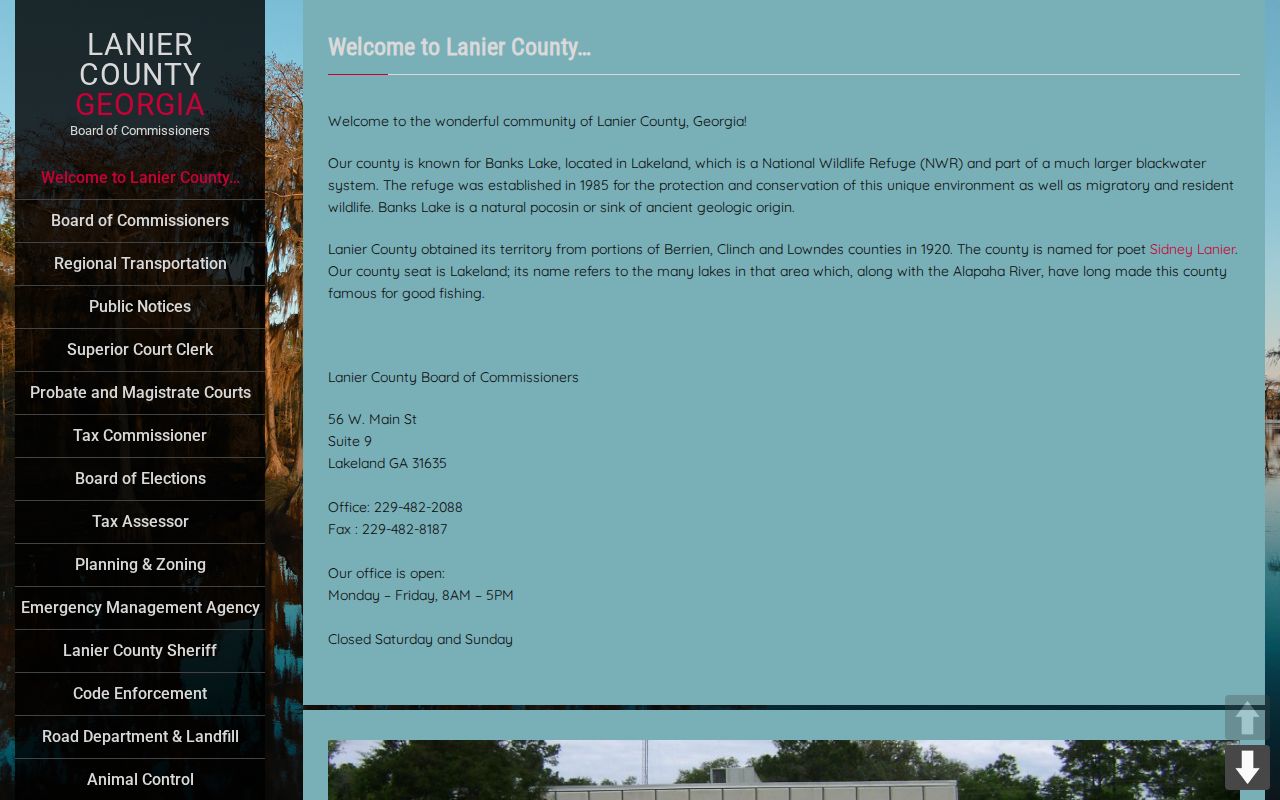
That page is the official county source. The court type still decides which suite and portal should get your docket question.
Superior Court Clerk
56 W. Main Street, Suite 5
Lakeland, GA 31635
229-482-3594
Probate Court
56 W. Main Street, Suite 10
Lakeland, GA 31635
229-482-3668
Magistrate Court
56 W. Main Street, Suite 10
Lakeland, GA 31635
229-482-2207
Finding Lanier County Court Dates
The Alapaha Judicial Circuit calendar index posts monthly, annual, weekly-hearing, calendar-call, and civil-trial schedules. Its monthly sheet uses labels like Lanier Civil and Lanier Criminal. Other labels include Felony CC/Pleas, DJJ, DFCS, and Jury Trials. Treat those lines as schedule summaries, not complete case dockets.
Probate traffic and Magistrate sessions both run on a third-Thursday rhythm, though at different times. Probate traffic arraignments are listed at 9 a.m., with bench trials at 1 p.m. Magistrate Criminal Offense and Deposit Account Fraud arraignments are listed at 10 a.m. Bench trials follow at 1 p.m. Confirm any setting through the court record and office before you appear.
For a fuller workflow, see the Lanier County court calendar. It walks through schedule sources and what to do when a setting changes.
When a Lanier Calendar Lacks a Case
A public circuit PDF may show only the county, date, time, and setting label. The case number, party, judge, and courtroom can all be missing. Match the calendar line to the individual docket. Then call the responsible court if the two disagree. For traffic matters, remember that a continuance needs approval. Submitting a request does not move the date by itself.
Key point: A calendar category confirms a session, not a person's place on it. Use the case docket or clerk confirmation for the individual setting.
Weather and judicial-emergency orders can shift operations too. A fresh circuit notice beats an older downloaded schedule.
Public Access to Lanier County Court Dockets
Public access in Georgia is broad but not unlimited. Court-specific rules, sealing orders, privacy protections, and redaction duties all govern court records. When an online image is unavailable, the responsible clerk can supply a public or redacted copy. A portal's absence never licenses you to bypass a restriction.
Key Rules:
Georgia Open Records Act guidance describes access, response, cost, and lawful withholding principles.
Uniform Superior Court Rule 21 governs public access, sealing, notice, and protected identifiers.
Georgia Juvenile Data Exchange rules make clear that JDEX is an authorized-user system, not a public search.
Sealed cases, juvenile matters, adoptions, unsigned proposed orders, and protected identifiers may be withheld or redacted. If an office denies a requested public record, ask for the legal basis.
Why Lanier Juvenile Dockets Differ
The clerk's directory puts Superior and Juvenile under one clerk, yet access works differently for each. State confidentiality rules shield juvenile proceedings because they involve protected child information. JDEX sits behind authorized access only. So call the clerk, describe the juvenile record you need, and let the court decide what law allows it to release.
One caution worth remembering. A missing juvenile result does not prove the proceeding never happened, and no other portal should be used to slip past the restriction. Calendar labels like DJJ or DFCS only mark a category of court work; they are not a public list of children or cases.
The Lanier County Clerk and Docket Records
Patricia L. Bass holds the Clerk of Superior Court post for Lanier County, according to the Georgia clerks directory. Her office is the place to go for civil court docket records and felony criminal filings. It also holds Superior Juvenile records in Lanier County. Need a certified copy of a Superior filing? The clerk issues those. The office also holds older Superior material or anything PeachCourt cannot resolve.
The clerk-directory listing displays the office and court assignment, which tells you exactly where to route a Lanier County docket request.
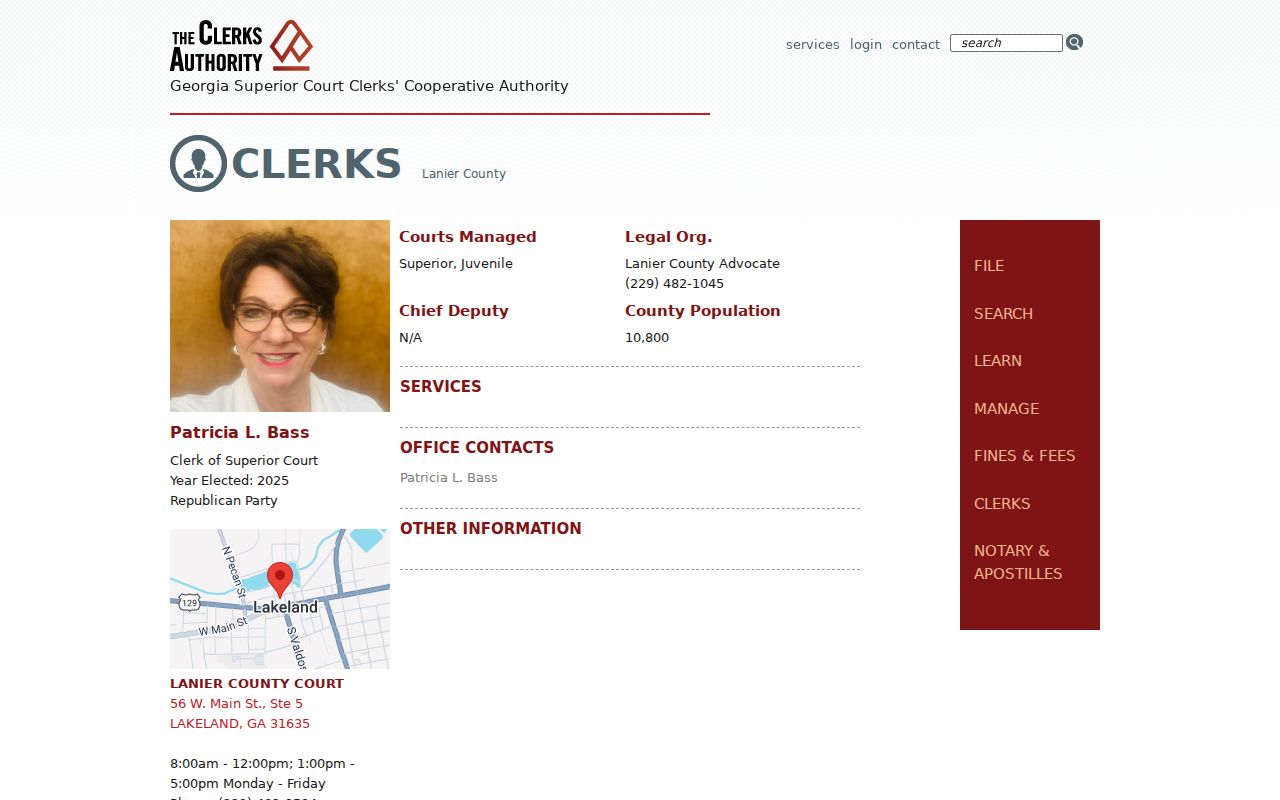
Other records live elsewhere. Probate, Magistrate, traffic, and municipal files each stay with their own offices, even though the Superior Clerk serves as the primary clerk for the county's general-jurisdiction court.
Clerk of Superior Court
Patricia L. Bass
56 W. Main Street, Suite 5
Lakeland, GA 31635
229-482-3594
Monday through Friday, 8 a.m. to noon and 1 p.m. to 5 p.m.
Lanier Probate and Magistrate Access
Lanier County's lower courts run through the local Probate and Magistrate court site. From there you can reach traffic court, probate, Magistrate filings, payments, and records requests. The site keeps its public docket listing separate from the PDF documents behind it. That split matters. A traffic docket search can return an entry without showing you the actual filing.
The portal home page is the working starting point. It serves several of these lower-court channels.
When a public document is missing online, the request form asks for the division, case number if known, party names, record type, date range, and details. Expect one case per request and roughly three-to-five business days. The county's Probate and Magistrate overview adds another official view of jurisdiction and contacts.
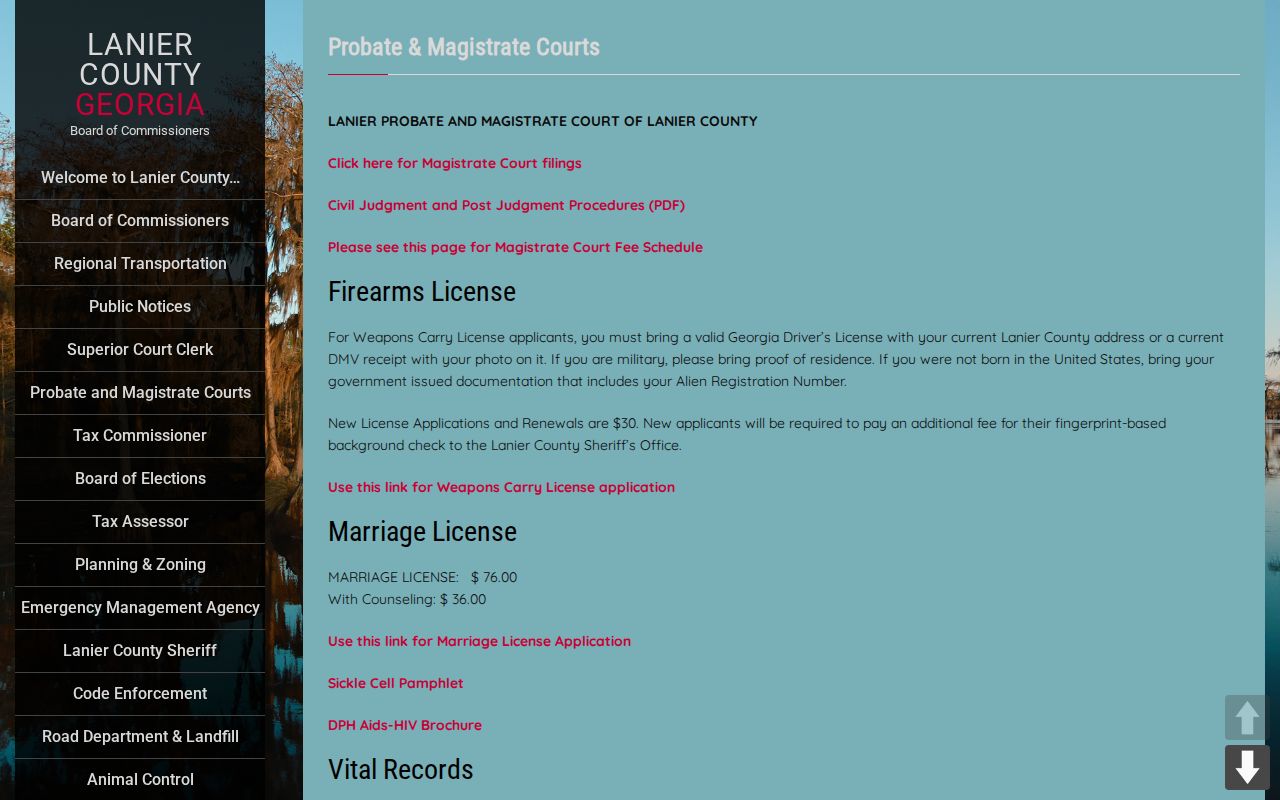
Taken together, the lesson is simple: any Lanier County docket question must name both the court and the record type.
Lanier County Copy Costs
What a copy costs depends on the record and the channel. PeachCourt posts a document-image price. Local request forms warn that copy, certification, or extensive research charges may apply. The Superior Clerk publishes no complete Lanier fee table for plain, certified, or exemplified case copies. Confirm the exact amount before you order.
| Item | Published rule or amount |
|---|---|
| PeachCourt document image | $0.50 per page plus a small convenience fee; exceptions vary |
| Probate/Magistrate request | Copy, certification, or extensive research fees may apply |
| Public-record copy guidance | Up to $0.25 per page under the Attorney General FAQ, with qualifying cost rules |
| Superior certified copy | No complete Lanier amount located; call the clerk |
Ask for a cost estimate up front. Say whether you need a plain image or a certified copy. Or say you want the full file. A narrow request is easier to price than a demand for everything tied to a name. Include the court, case number, record type, and date range whenever you can. For Probate, Magistrate, or Traffic material, the local form takes one case per request. It warns that only public records can be released. Route Superior requests to the Superior Clerk instead of the lower-court form.
Certification is not e-filing. GSCCCA runs statewide filing and eCertification tools for participating records. Confirm Lanier Superior availability and the right certification route with the clerk. A portal receipt or a downloaded screen is not a clerk-certified court record.
Lanier Court Technology Milestones
A quick history helps frame how Lanier court access grew. The county's first courthouse went up in 1921. The present modern courthouse followed in 1973, with a jury-room addition in 1986. Today access runs through PeachCourt, Georgia Probate Records, Georgia Magistrate Records, TruFiling, eFileGeorgia, EZCourtPay, and request forms. No official source pins down one reliable date for when Lanier court records went digital.
Change keeps coming, too. Georgia legislation created a third Alapaha Superior judgeship effective July 1, 2026. That adds judicial capacity to the circuit. It does not create a new Lanier County court docket portal. Existing cases still follow the provider and clerk routes tied to their court.
Online access and electronic filing also play different roles. PeachCourt can support both Superior docket access and filing. TruFiling and eFileGeorgia are filing channels linked to Probate or Magistrate work. A filing login is not a public name-search page. Georgia's E-Access directory points users toward providers. It does not merge their results. That is why one Lanier County case can involve a filing account, a public docket view, and a separate clerk request for a certified document.
Historical coverage varies by provider and court. PeachCourt says most participating courts commonly have docket data back to 2005. That statement is no Lanier-specific guarantee. Georgia Magistrate Records and Georgia Probate Records publish no firm refresh schedule or complete local coverage date. A recent filing may take time to appear, and an old file may never have entered the public index.
Older records can predate online coverage entirely. Rather than assuming a portal's earliest visible year marks the start of court records, ask the clerk about archives or other retained formats. Give the office a case number, party names, an approximate year, and a document type. That helps staff locate the right collection.
Court Dockets by City in Lanier County
Lakeland sits inside Lanier County and carries the county's heaviest load of local court business. Ray City is a different story. Its incorporated limits cross the Lanier line. Georgia's tax listing ties the city to Berrien. So check the ticket first. A citation written by city officers belongs in that city's own municipal docket, not the Lanier Probate portal.
Lakeland Court Docket
2020 population 2,875. Municipal citations use the city-linked nCourt channel.
Ray City Court Docket
2020 population 956. City traffic and ordinance matters use Ray City channels.
Where you live does not steer the bigger cases. A county-issued traffic ticket stays in Lanier Probate Court no matter the driver's address. Felonies and major civil filings land in Lanier Superior Court every time.
Map and Directions to the Lanier County Courthouse
Superior Court felony, civil, and Juvenile records are kept by the Clerk of Superior Court in Suite 5 of the Lanier County Courthouse, 56 W. Main Street in Lakeland. Probate and Magistrate Courts share the same building in Suite 10. The current courthouse was built in 1973, replacing a 1921 courthouse, and gained a 2,900-square-foot jury-room addition in 1986; the county's own comprehensive plan says the building was originally designed for ADA accessibility.
Lanier County Courthouse / Clerk of Superior Court
Patricia L. Bass
56 W. Main Street, Suite 5
Lakeland, GA 31635
229-482-3594
Monday through Friday, 8 a.m. to noon and 1 p.m. to 5 p.m.
No parking diagram, security-screening policy, or public-terminal count is published for the courthouse, so calling 229-482-3594 before a special trip is the safer plan. Probate (Suite 10, 229-482-3668) and Magistrate (Suite 10, 229-482-2207) keep the county's general 8 a.m. to 5 p.m. office hours; confirm their exact counter hours directly.